Caked powder: restoring flowability and saleable condition
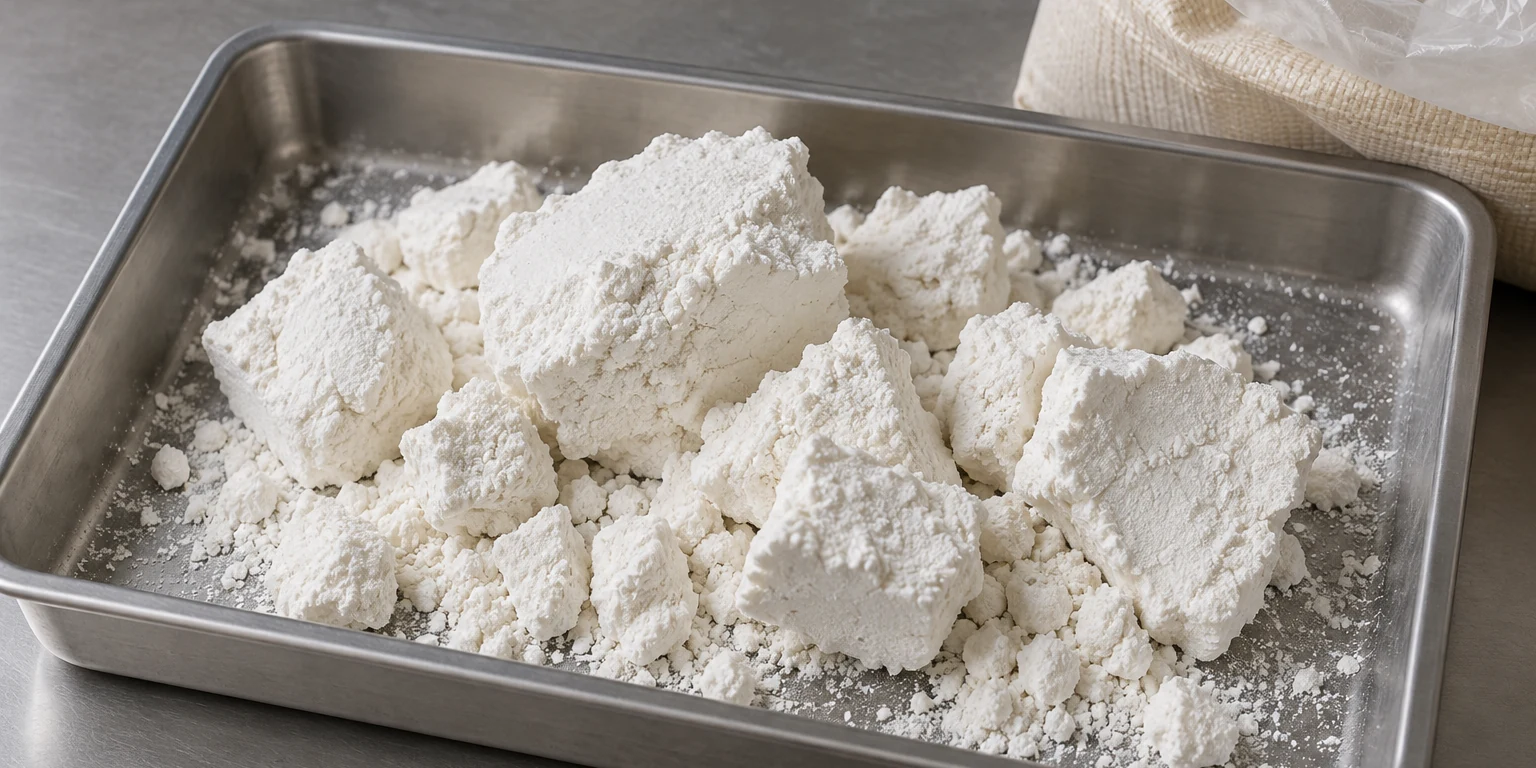
For example, a shipment of a bulk ingredient arrives from China, but the bags contain a single hardened mass instead of the usual powder. The product may still meet its specification: only its physical form has changed. In this situation, crushing and sieving may restore its saleable condition.
Why does powder turn into a hardened solid block during transport?
Caking is caused by moisture, temperature changes, pressure and time. Each factor may have a limited effect on its own; together, they can turn a free-flowing product into a dense block over several weeks in transit.
The mechanism is described in Zafar and colleagues’ review, “A review of bulk powder caking” (Powder Technology, 2017). Moisture condenses in the gaps between particles and forms liquid bridges. Some of the substance dissolves in this moisture and then recrystallises as it dries, turning the liquid bridges into solid ones. The particles bond together. The authors also note that caking takes appreciable time and involves changing conditions. In one study they discuss, the strength of a lump of table salt increased linearly with the number of temperature cycles; in another, caking was more pronounced in particles smaller than 250 µm.
A sea freight container produces exactly these cycles. According to the Transport Information Service (TIS) handbook published by the German insurance association GDV, at an outside temperature of around 25 °C, air inside a brown container heats up to approximately 50 °C. At night, the walls and roof cool down and moisture from the air condenses on them. This condensation is known as “container sweat”. It can drip onto the cargo from the roof and may not dry out completely during the day. Each day in transit adds another wetting and drying cycle.
The third factor is stacking pressure. The lower bags bear the weight of those above them, pressing particles closer together and making it easier for bridges to form. The same review identifies reducing the load on a layer of material as one way to prevent caking.
Which powdered ingredients are more prone to caking?
Hygroscopic, finely divided and partially amorphous products are affected more often. The specification and safety data sheet for the particular substance indicate its susceptibility and the storage conditions specified by the manufacturer.
Hygroscopicity—the ability to absorb moisture from the air—varies between amino acids, vitamins and food acids. A product with large crystals and a narrow range of particle sizes cakes more slowly than a fine powder containing a large proportion of dust. For amorphous substances, the review also highlights the glass transition temperature: if this is exceeded inside the container, particles start to fuse together and the lump becomes stronger. The substance’s name alone is therefore not enough; the documentation for the specific batch needs to be checked.
Can a caked product’s saleable condition be restored?
Yes, if the caking is physical: particles have bonded together through bridges, while the substance itself has not changed. Lumps are broken up by gentle size reduction, then sieved to the required particle size and packed into new packaging.
The usual sequence is:
- Open the packaging and inspect the product: colour uniformity, odour, foreign matter and signs of moisture.
- Break up the blocks by crushing or grinding. Select settings that break the lumps without grinding the ingredient’s particles into dust.
- Sieve using equipment with the specified mesh aperture. Return the oversize fraction for further size reduction.
- Check the result: flowability, particle size distribution and, where needed, laboratory parameters against the specification.
- Pack into sealed packaging with an inner liner and apply labelling.
One limitation should be considered beforehand. Any size reduction produces some fines. If the buyer of the finished product requires a strict particle size distribution, this must be discussed before work starts: it affects crushing settings, equipment selection and the quantity screened out.
What should be checked before reprocessing?
Before crushing, the product’s quality parameters need to be checked against the manufacturer’s documentation. In physical caking, crushing ingredients changes their form rather than their chemical composition.
- Batch documentation. The manufacturer’s specification, certificate of analysis (COA) for the particular batch, production date and expiry date. These documents establish the parameters against which the reprocessed product should be compared.
- Packaging integrity. Torn bags or boxes, wet patches and signs of leaks on cartons and pallets. Caking in intact packaging and caking in wet packaging present different risks.
- Sensory characteristics. Colour, odour and uniformity. Yellowing, darkening or an unusual odour indicate chemical changes rather than lumps alone.
- Laboratory parameters. At least the mass fraction of the principal substance and moisture content (loss on drying), measured using the method in the specification. Food products must meet the requirements of Customs Union Technical Regulation TR CU 021/2011 “On Food Safety”, as applicable in Russia.
- Labelling after repacking. Food products placed in new packaging are subject to Customs Union Technical Regulation TR CU 022/2011 “Food Products in Terms of Their Labelling”. The information on the label and responsibility for labelling should be agreed before packing, taking the regulation’s requirements into account.
These checks protect both the product owner and the processor. Under Article 716 of the Civil Code of the Russian Federation, a contractor must immediately notify the customer if the supplied material is found to be unsuitable or defective, and suspend work pending instructions. An incoming inspection makes this point clear to both parties in advance.
When is reprocessing not worthwhile?
Crushing and sieving will not restore a product’s quality or functionality if its chemical parameters have changed, it has been contaminated or exposure to moisture has put it outside specification. In these cases, changing its form does not eliminate the cause of non-conformity.
- The mass fraction of the principal substance is below the specification’s limit, or decomposition products have appeared.
- There are signs of mould, foreign matter or moisture exposure after which the product no longer meets its specification.
- The product has expired. Grinding, sieving and repacking do not extend an expired shelf life.
- The moisture content exceeds the allowable limit for the ingredient. Crushing or grinding alone is not enough to remove excess moisture: new packaging will trap it inside, and the product may cake again.
If one part of the batch passes inspection and another does not, they should be processed separately. Acceptable product must not be mixed with questionable product to increase volume: the buyer’s checks would produce an average result that may not meet the agreed parameters and specification.
How can repeated hardening and caking be prevented?
The causes of hardening or caking must be identified and eliminated: moisture, sharp temperature changes and pressure during storage and transport. Sealed packaging and compliance with the required storage conditions help prevent repeated caking.
Frequently asked questions
Does crushing and sieving change the product’s composition?
In physical caking, the product’s chemical composition does not change: reprocessing changes particle size and flowability. Quality parameters are checked against the specification before reprocessing; requirements for particle size and functional characteristics are agreed beforehand.
Can only part of a caked batch be reprocessed?
Yes. Product often hardens only in the lower rows of stacked bags or around the edges of the batch, while the remainder retains its original appearance. The quantity to be reprocessed is determined following inspection.
Are laboratory tests needed before reprocessing?
Laboratory testing is advisable, particularly if there are signs of damaged packaging or doubts about the batch’s quality. The minimum parameters are the mass fraction of the principal substance and moisture content, measured using the manufacturer’s specified method.
How much does reprocessing cost, and how long does it take?
Price and timing are discussed after an enquiry is received. They depend on the product type, batch quantity, extent of caking and the customer’s requirements for the scope of work and particle size.
If you have a caked or heavily hardened batch, describe the product and quantity in your processing enquiry. We will review the documentation and suggest a sequence of work.
Sources
- Civil Code of the Russian Federation, Article 716
- Customs Union Technical Regulation TR CU 022/2011 “Food Products in Terms of Their Labelling”
An example from our work: reprocessing 70 tonnes of caked glycine and reusing the original manufacturer’s bags. The case study shows the stages of preliminary crushing, further size reduction and repacking into 25 kg bags.